Friday, 24 June 2016

June 24 - 26 Tbilisi to Sighnaghi and the Kakheti region


King Gorgasali of Caucasian Iberia founded Tbilisi and keeps watch over the capital

Beautiful modern and futuristic-looking buildings in newer parts of Tbilisi
Tbilisi is a conglomeration of the old and new all jumbled together in a fairly small area - compared to sprawling Melbourne! We focussed on the old - exploring the winding streets of the old city, peering into churches dating back thousands of years, before walking the ruined ramparts of the C4th Narikala fortress on the craggy heights where it once guarded the old city. 
Tibilisi's Sioni Cathedral of the Dormition - a Georgia Orthodox Cathedral
Some old houses in a back street

Mother Georgia - all former Soviet countries have a massive statue of a warrior mother
From there we trekked down to the millennia-old Sulphur Baths fed by a waterfall and creek at the bottom of the precipice. We happened on some exuberant and totally unexpected entertainment which was rather a treat - a traditional Uzbeki dance celebrating a wedding in the square outside the Sulphur Baths.
The Sulphur Baths are under the domes in the background to this wedding party
We completely forgot time in the National Museum of History. The two of us had a personal tour led by the museum's longest-serving guide - she has been guiding there for 50 years. What she doesn't know about Georgian history and treasures is probably not worth knowing - we felt very privileged.  One fascinating piece of their history is the discovery of the remains of a new species Homo georgicus ~2 million years old in Dmanisi Georgia.  In light of the discovery, the belief is that there may have been two waves of migration - one into Africa from the Caucasus, followed by one out of Africa. A fascinating and unexpected 'discovery' for us. It is a land of wonder with many pre-history treasures. A collaboration between the National Museum of Georga and the University of Melbourne has teams of archaeologists working in Rabati in southwestern Georgia where they have uncovered evidence of sophisticated human settlement dating back at least to 5000 BCE. The excavations continue.
Lindsay with the tamada - a Georgian traditional toastmaster
Dinner on the rooftop terrace of our hotel sipping Georgian wine and watching the lights come on across Tbilisi was a perfect way to end a wonderful first day.
Roof-top restaurant in our hotel afforded wonderful views over the city
As we drove east the following day into the Kakheti region, we passed what seemed like an almost endless line of fruit stalls along the side of the road selling huge watermelons, peaches and an array of other fruits and of course, buckets spilling large ripe tomatoes ...... and slaughtered pigs! There they were, fresh-killed chunks of pig - pale pink mysterious shapes hanging by the roadside inviting people to buy, some cuts wrapped in cloth, others just swinging naked in the breeze. Bizarre sight for we overly-sanitized and refrigeration-oriented visitors. 
We called into Khareba winery for a tour and tasting and came away with 4 bottles to enjoy along the way. Then we were taken to a local farm where the family treated us to a delicious lunch with fruit and vegetables from their garden and scrumptious pork shashlik all topped off with homemade cheese, wine, bread and chachas - their local fiery grape vodka which is pretty potent stuff!  The whole experience was excellent.
A delicious meal prepared from their own farm produce plus home-baked bread

The qvevris were buried in the floor and sealed. Centre: these are 100s of years old. R: a modern version
Georgian wine is very special. With a history of 8000 years, it is one of the oldest wine-making regions in the world. They still make wine using the traditional fermentation method in underground claypots (kvevris) which has been UNESCO listed as Intangible Cultural Heritage, but alongside the newer European method. Both varieties taste of sunshine and rich soil - the wine is not readily available in Australia but do ask for it nevertheless, it is really worth a taste. We drove to visit a farmer's house to see a 300-year old wine cellar and drank wine straight from the ancient clay jars, the qvevris.
We spent the night is the picturesque Sighnaghi, the eastermost region of Kakheti looking out over the vast Alazani Valley.
View from Sighnaghi over the vast Alazani Valley with the Caucasus Mountains in the distance

June 24 Beautiful Georgia - the beginning of a wonderful sojourn

I have run out of superlatives! Georgia exceeded our expectations. It is so beautiful, the food and wine delicious, the culture so rich in history dating back to pre-history. So you might think why not just leave it there? But the devil is in the detail as they say so I will attempt to describe some of what we saw and experienced. Our guide Nino, a born leader and passionate advocate for her country and fellow Georgians, brought it alive for us. Together with Gia, our excellent driver, we were about to travel 2000 or more kms from the capital Tbilisi, east into Kakheti, the wine and fruit growing regions, north to one of the highest glaciers in the Caucasus (Mt Kazbegi 5047m), west to the upper Svaneti region. Both regions are in the Greater Caucasus Mountains and the roads are pretty rough. And finally we headed south for another of the highlights of the trip - the C12th cave city of Vardzia.

Where to start? The following posts barely skim the surface of our amazing trip but first a map of our travels through this jewel of a country nestled in towering mountains. Note that we had to skirt South Ossetia when travelling from east to west and we could not go further west than Svaneti as that abuts the border with Abkhazia. That and South Ossetia are both separatist regions in Georgia that have declared independence but are not internationally recognised. They are not friendly neighbours. (Those regions are delineated on the map with green broken lines.)
The journey we took through Georgia starting from Yerevan


Thursday, 23 June 2016

June 22-23 Armenia - millennia of history in two days!

Flying over the Caucasus Moumtains
We hadn't intended visiting Armenia, but it was a surer way to getting out of Russia before our visas expired and into Geogia - flights to Armenia are international flights whereas those to Georgia are regarded as domestic and subject to delays or cancellation. We wished it could have been a much longer visit. Flying into Georgia over the Caucasus Mountains was quite amazing for me as they were the stuff of legends telling of distance places.  But here we were! Armenia and Georgia nestled among the Caucasus Mountains, are sandwiched between the Black and Caspian Seas and over the millennia have been a vital corridor between Asia and Europe and between Islam and Christianity.
Armenia and Georgia (and Azerbaijan) sit in the mountainous corridor
The biblical Mt Ararat pretending to be a cloud
We arrived in Yerevan about 10pm and were whisked away to our hotel and promptly served a lavish 3-course meal. I have to say that the service we have had throughout this trip has been superb (thank you Sundowners Overland) but tonight we were dead on our feet and just wanted to fall into bed - but one can't be rude. So we sat through a delicious array of courses. Over the next two days we whirled through Yerevan, a city and culture of Biblical proportions, pockmarked with the remnants of the Soviet period but celebrating renewal and a return to its roots. This is a new Presidential Republic sitting on top of millennia of history. It is a nation which hung on tenaciously while powerful neighbours bit off large chunks of their land (and continue to nibble at their borders), through periods when there was little to eat. There is a sense of renewed hope and an immense and palpable national pride. And the ancient Mt Ararat keeps watch over the renewed capital a mere 60 Kms away. 
Yerevan is often referred to as the 'Pink City' because many of the new buildings are constructed in pink tufa, a porous limestone rock. Most of the structures built during the Soviet period are of black tufa. The soft pink stone brings a symbolic lightness and glow to the city.
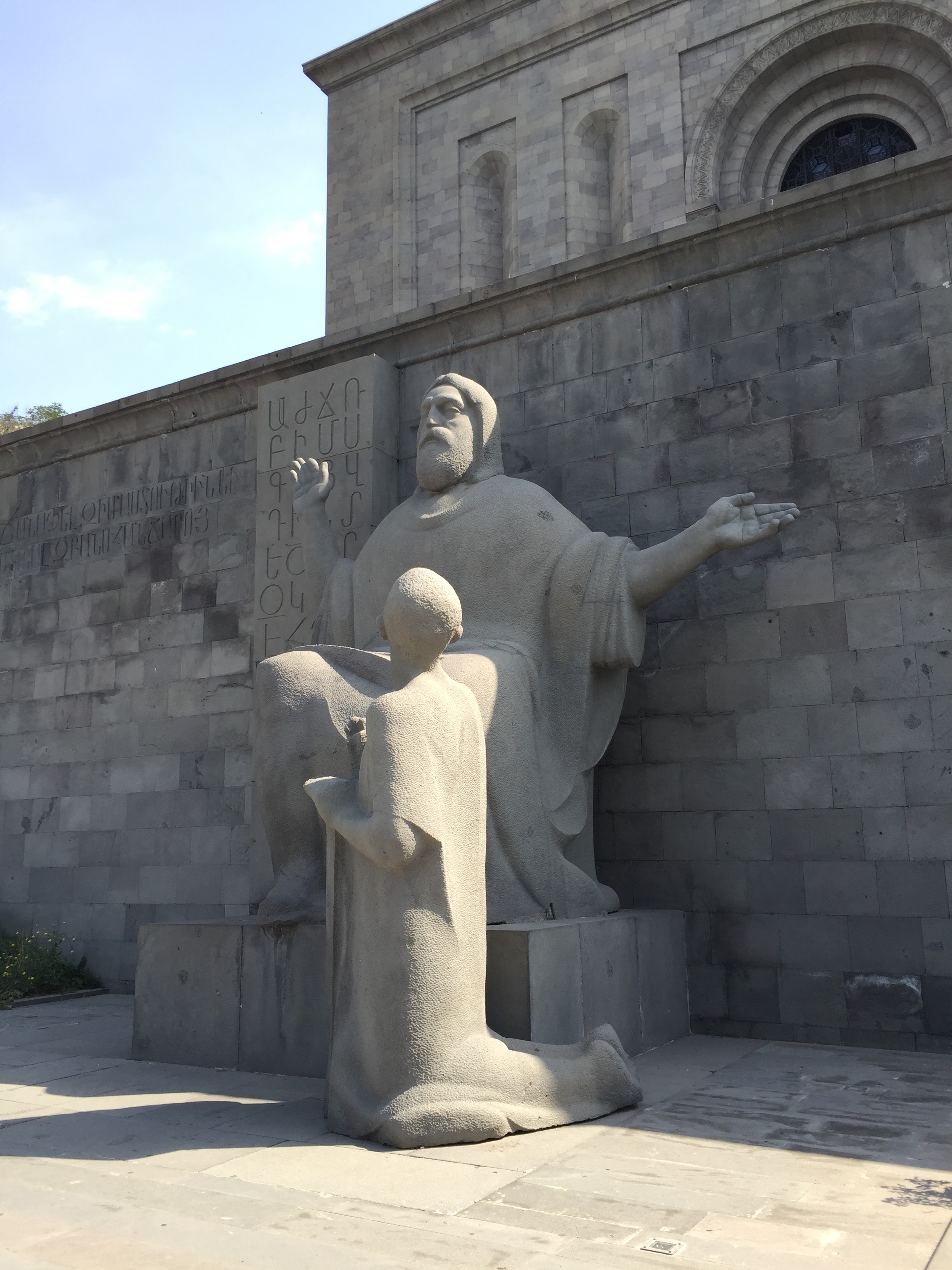
Our first day we toured the city's highlights including a visit to Matenadaran, Mesrop Mashtots Institute of ancient Manuscripts. This is an absolutely fascinating repository of ancient manuscripts - religious, mathematical, scientific, botanical. I could have spent hours there. As we toured, our guide gave us a extensive, albeit potted, account of her country's history and culture from many millennia BC up to today.  Something which quite fascinated me is not only that Armenia has its own language but that it has its own alphabet of 39 letter developed around 450 AD by Mesrop Mashtots.
Mesrop Mashtots developed the Armenian alphabet and language 405 AD

On display were many botanical and geological specimens used to extract coloured pigments
Education is a precious commodity in Armenia and there are many academies, universities and colleges. Our guide has a Master's degree from Padua University where she examined the links between traditional dance and culture and what information folk dances reveal about the local culture. She is collecting/documenting many dances for posterity - much like Komitas' exploration and collections of Armenian folk music. We were treated to a performance of traditional dance and song accompanied by traditional instruments - drum and duduk, an ancient flute made from the wood of apricot trees. It produces a beautiful and plaintive sound.
Armenia boasts an enormous collection of ancient manuscripts which are used by international scholars
Our lessons in history were thus richly supplemented with stories of age-old traditions, the glue that has kept the Armenians strong at heart. We tasted delicious soup made from yogurt, wheat, and coriander, watched coffee being cooked in sand, sampled brandy from the Mt Ararat brandy distillery and at every meal sat down to a veritable feast which always included tomato and cucumber salad, local apricots (the best I have ever tasted), cherries and strawberries. 
As the first Christian nation, Christianity is intrinsic to the psyche of the people and their country in spite of almost a century of Soviet rule which saw a number of churches 'closed'. Their history is inextricably woven through with their Christian roots. (I remember the first time I was made aware of Armenia. I was listening to an interview about Komitas, and it sowed the seed of curiosity and a dream to visit the country. We will visit again in 2025)  We visited many ancient churches and monasteries, a few of which have been UNESCO World Heritage listed to ensure the protection of cultural and natural history. We found many such places here - also in Georgia in subsequent days.
Lake Sevan
We had but two days to see what we could of Armenia before crossing the border into Georgia. Just as a matter of interest, Armenia is also referred to as Hayastan - the land of the Hayar people, the Armenians. The economy is based on mining and agriculture and as we traveled northeast to the border, we passed areas where obsidian and moonstone are mined near Lake Sevan. Lake Sevan is absolutely beautiful.  It is one of the largest freshwater high-altitude (2000m) lakes in Eurasia and certainly the largest in the Caucasus region. It provides 90% of the fish and 80% of the crayfish catch of Armenia.  Copper is mined in the north around the Lori region as well as in the south. As we got into the foothills of the Lesser Caucasus Mountains we traveled through forests of beech, plane, pine, oak, elm - it was quite breathtaking!
Haghpat, one of the numerous UNESCO-listed monasteries
After a sumptuous lunch overlooking an immense valley in the Lori region, we spent a magical hour wandering around the UNESCO-listed Haghpat Monastery complex where our guide sang a most beautiful ancient love song which echoed up into the soaring vaults of the church - it was very special and took our breath away. 

Beneath the monastery floor were wine vats - also used to hide treasures from invaders

Haghpat Monastry - doors to the church
Thus ended a very special, albeit far too short, visit to this ancient place and culture. We then walked across the River Debed from Bagratashen in Armenia to Sadakhlo in Georgia where we were picked up for the 50 km trip into Tbilisi, the capital of Georgia. 
At the border of Armenia there is a sign with a map of the country. It is an interesting shape. Once it was considerably larger than it is today, spreading west along the Black Sea but in the early 1900s it was seized by the Turks. To the east, Azerbaijan has bitten off large chunks of and continues to nibble at its border.  Yet this tenacious little country hangs on. And we are about to go over the border to another country, also once part of the Soviet Union, a country which similarly has big dogs snapping at its borders. In fact, two large chunks, Abkhazia and South Ossetia, once autonomous regions of Georgia, have been the subject of conflict and international dispute since the collapse of the Soviet Union.  Enough! we are about to enter Georgia, the next and last phase of our journey.
The red lines denote the borders of Armenia and Georgia


Wednesday, 22 June 2016

June 20-22 Moscow Moscow dah dah dah ........

One of the things we missed on our train journey was seeing the Ural Mountains. It was a little disappointing as they mark the transition from Asia to Europe and take me back to enjoyable geography lessons at High School, but what can you do? We crossed them in the dead of night. However ......Moscow! 
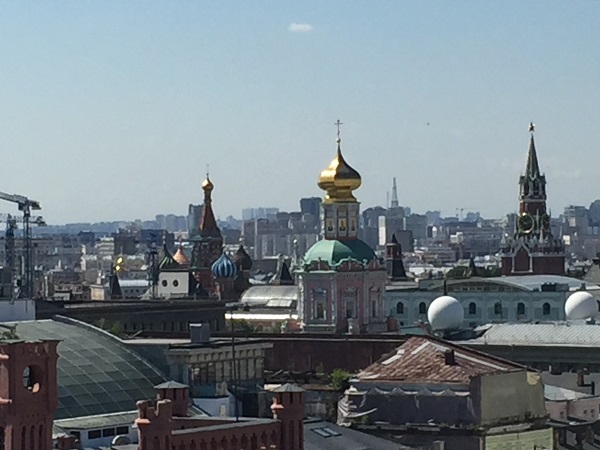
This could only be Moscow! Quite magnificent
It is huge, almost overwhelming, architecturally grand, crowded, fascinating and elegant in a way that redefines 'cosmopolitan'. Famous names, buildings and historic events confronted us at every corner. The skyline and rooftops fascinated me - they seemed so Moscow - and the buildings ....! 
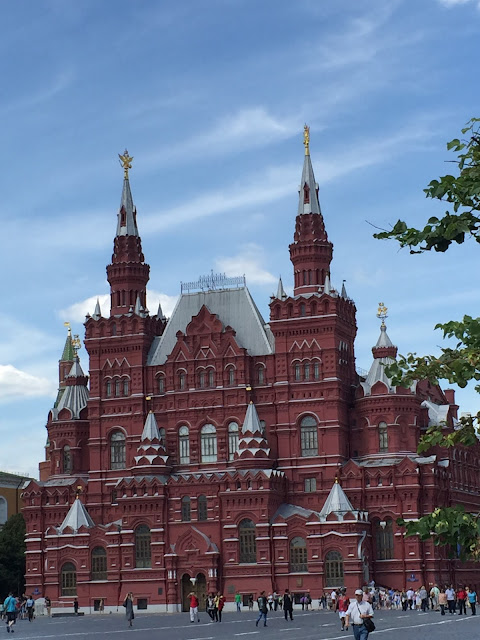

The Historical Museum built late 1800s (we didn't get to visit)
We walked and walked, taking in the heart of Moscow from Red Square and the Kremlin to the magnificent Metro stations with their mosaics and sculptures. Dimitri, like all our Russian guides, was very knowledgeable and had a deep passion for his country. Our Russian guides all had tertiary degrees in languages, tourism, etc and they were always open to probing questions, so we felt very fortunate.
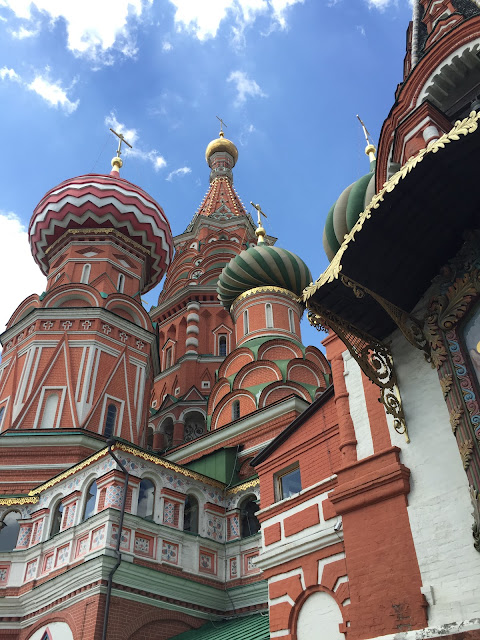
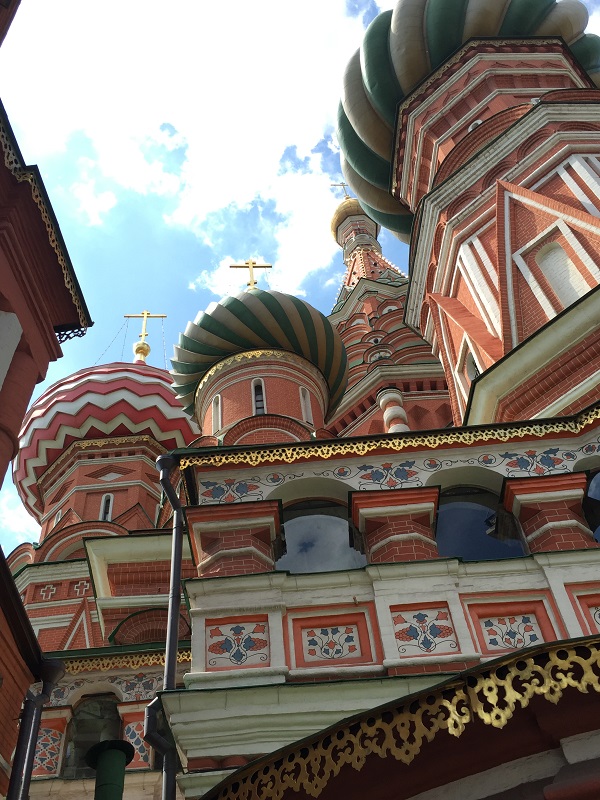
The big highlight for me, well there were two actually, but the first - St Basil's Cathedral! Wow and again wow! We visited it on both days: first to walk the perimeter and take lots of photos and simply soak in its beauty and then to return the following day on our own to explore its inner sanctums. It was a Lewis Carroll dream in living colour - cupolas of brightly coloured boiled lollies of giant proportions, domes of colour and phantasmagorical patterns - I walked around with my mouth hanging open. Everywhere you looked was something new - turn a corner and look up and there we were met with yet another dome or spire or new roof perspective, a different pattern painted or carved and almost hidden in a small alcove or high under a lofty domed ceiling, a quirky totally unnecessary decoration tucked into an unexpected spot. What a fantasy place! We climbed narrow spiral stairs between floors and in one magic moment I turned a corner in a narrow passageway and heard the most beautiful singing. One could have imagined that angels live in this glorious place and do nothing but sing with joy or sorrow. But no, it was a small group of monks lost in a Gregorian chant which echoed down through the darkness of this single frescoed passage in the vast labyrinth of curved passages and rooms. 

A different perspective on this fantastic cathedral

Ceilings disappeared into elaborate domes, even the crypt was fascinating in its simplisity

Every corner you turned gave a different perspective of this magnificent structure
In the end of course, we had to leave, but it was a 'bucket list' day for me. Why? Because as well as visiting this magical place, which incidentally was built to celebrate vanquishing the Mongols, we visited a few of the famous underground Metro stations. 
The Metro is everything people say it is - and more!
The dog's nose and leg glow gold because people constamtly touch them with affection

Most ceilings had cameos depicting parts of Russia and its people's history


From glitz to art deco or nouveau - no two were the same (we visited many!)
Words fail me as always, but the Metro stations we visited lived up to, and beyond, my expectations. Intricate mosaics and bas-relief sculptures, massive bronze statues gleaming gold where people touch them every day on their way to and from work - a boy's knee, a dog's nose and so on for luck or peace. All the images and cameos told the history of Moscow and Russia. They are palaces for the people, history and art museums, built into everyday life. 
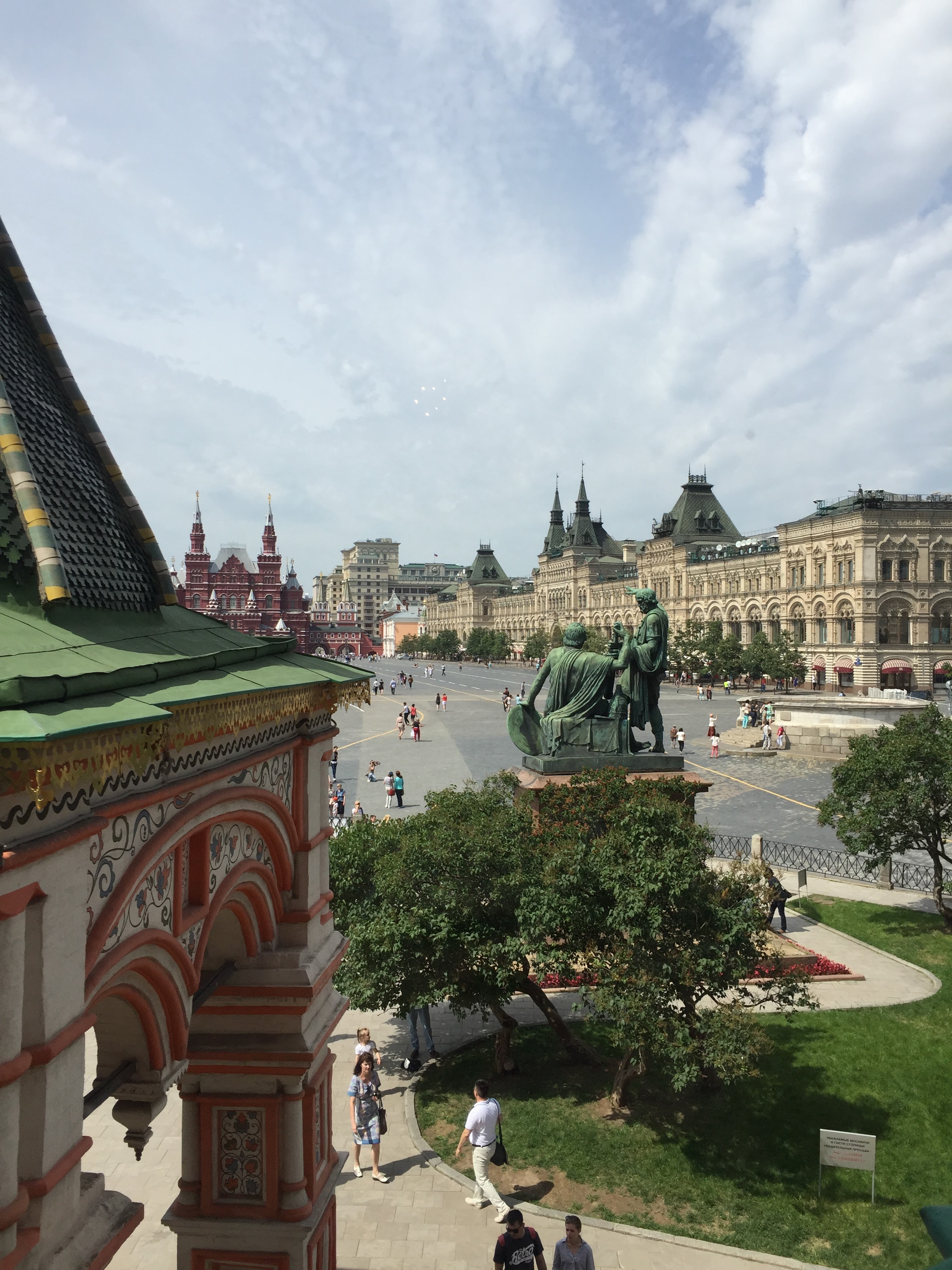
That large building on the right is GUM
We had our Moscow guide for an entire day and what a day! We headed out at 9am (after our 4am arrival!) and didn't stop until after 7pm. After a whirlwind day of walking around buildings, the Metro, Red Square, etc and a visit to Moscow's oldest supermarket - Gastronomia Eliseevsky (GUM). But we also had a look through a huge toy emporium as well as GUM.  GUM was built in the late 1800s. During most of the Soviet period, it was essentially THE department store as there was only one vendor: the Soviet State. In the mid-1900s, it became one of the few stores in the Soviet Union that did not have shortages of consumer goods, and the queues of shoppers were long, often extending entirely across Red Square. Today it is a rather glitzy shopping mall. 

Absolutely beautiful indoor market full of marble, chandeliers and mirrors. 

The prices for caviar were eye-watering

Gastronomia Eliseevsky is an exotic food store-supermarket operating since mid C19. It's glorious and glamorous and very glitzy, selling imported and expensive goods - the caviar we saw ranged for $80 to $1000 per kg.
Ou
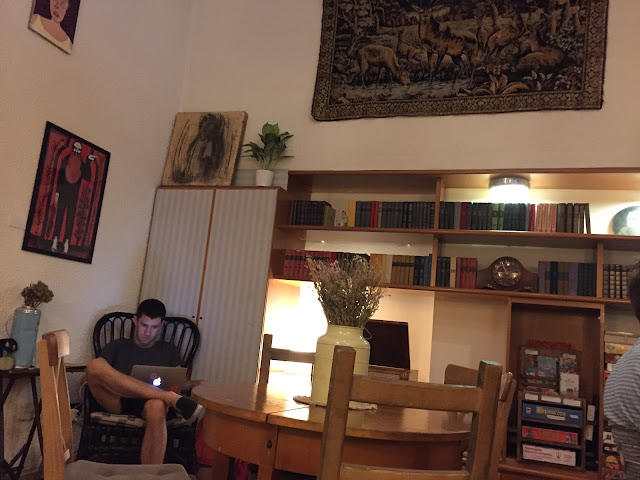
r day's journey of discovery with Dimitri wrapped up with a visit to a most unusual place. Tsiferblat, a coffee 'shop', one of the first 'anti-cafes' in Moscow, where you pay for time spent there rather than what you consume (RUB 2 for every minute in the first hour and RUB 1 thereafter).  It is run by a local artist commune and felt a little like a secret club - ring a bell on the outside wall and you are let into an old building, climb the stairs and knock - no password required but it felt like there should be! Once inside, you are greeted warmly, told to select a clock, all of which are named (ours was Eva) and that is recorded with your arrival time and your name and then you simple wander until you find a corner to your liking, make yourself a drink and chill out.  We were entertained by two different pianists - casual, spontaneous, just enjoying themselves playing for no one in particular. All very arty and rather reminiscent of the atmosphere of the coffee shops of the 60s.  One could imagine Dostoyevsky and Pushkin lounging there engrossed in philosophical debate - had Dostoyevsky been a few decades younger and had this place existed back then! One could imagine all sorts of business being conducted here - much perhaps clandestine. It was very laid back, but I can almost see spies doing deals and trading secrets in the corners - mysterious and magical at the same time.
This small plaque on the wall with an intercom gives you entree to Tsiferblat
A delightful place with many rooms and quiet corners

One of the pianists who had a lovely time 'playing'
The next day we headed out again on our own to negotiate our way through the Metro and to spend time on the Red HOHO bus for a more global view of the city.  We ended up spending at least 5 hours in a whirlwind tour which took in history, architecture, politics, religion, etc. It was wonderful but all too much to relate here - even if one could remember it all! But we saw old and ancient history celebrated in bronze statues in prime positions in front of new modern edifices, examples of architecture - like the 'Seven Sisters' from the Stalinist time reaching above the horizon like adornments on a crown. Moscow's architecture was strongly influenced by some of the wonderful buildings of early C20 USA - New York's Municipal Building, the Chrysler and Flatiron buildings for example. We wandered around part of the perimeter of the Kremlin and looked at the queues lining up to see Lenin's Mausoleum but kept going.
Marvellous view of the Kremlin from the bus 

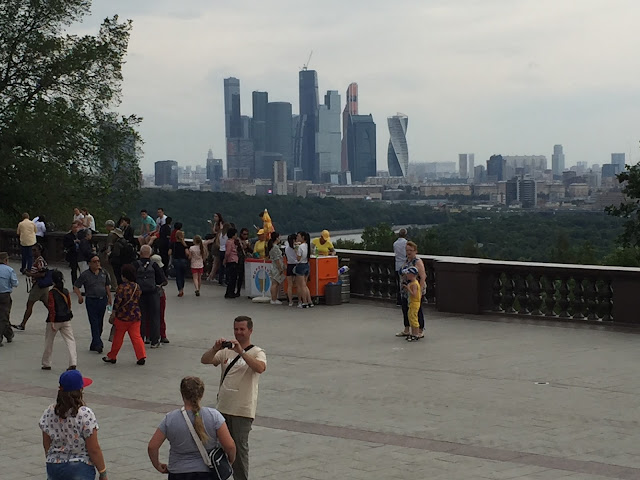
After spending time looking at old buildings, here we got a marvellous view of some of the modern city buildings 
Quirky restaurant
STOP in two languages
The following day was our last in Russia and we had but a morning to snatch a last look at this intriguing city. We visited the Izmailovo Market which was within walking distance of our hotel which was in the eastern district of Moscow and almost next door to the Partizanskaya metro station (we couldn't have been better situated). The architecture of this quirky flea market is borrowed from children's literature, I am sure. It is a jumbled conglomeration of phantasmagorical shapes and images. I loved it.  A crowded colourful and typical market to tempt tourists and locals alike. We had no room in our cases to buy anything, but the drawcard really was the 'roof of the market'.

A tempting tumble of badges and hats 

The 'roofline' of this market is phantasmagorical
Later that day we were picked up and taken to the airport. So ended our wonderful sojourn in Russia. We flew out of this intriguing country bound for Armenia with just hours to spare on our 30-day visas.