Thursday, 21 September 2017

The Murchison and Pilbara 5-7 September 2017

The Murchison and Pilbara both rather untamed landscapes, bear witness to sometimes foolhardy but always romantic human endeavours indicated by the grand old buildings and countless pubs. Lots of wealth has been, and is still being, torn out of the ground. One is very aware of the mines all round, but rarely sees them except for one monstrous plant along the road from Nullagine (an old gold rush town) to Marble Bar. Earth 'modification' as far as the eye could see. Staggering!
This is a\Acacia inaequilatera to the world but to me it's a blackberry wattle - you can see why. Cute isn't it? The flower ball is so unusual and the young leaves a delicate shade of soft maroon. We're in a place of diverse beauties - but of course, we are back in the Pilbara!!

On through Munjina Gorge
These monster truck movers will soon be on the Marble Bar road I think. We encountered these near Munjina on the skirts of the Karijini NP.

Ore trucks were regular passers by kicking up huge clouds of dust and stones - c'est la vie!


However ....... before Marble Bar we  passed through some pretty amazing countryside. 'Blackberry' wattle, banded behemoths, and butterflies! Here it's so dry birds and butterflies clustered around every small muddy patch on the ground. We park overnight at a wee roadside spot calked Auski Tourist village, AKA Munjina, right on the perimeter of the Karijini National Park in the Hamersley Ranges. Mining trucks zooming around everywhere but not so much that we haven't been able to appreciate the breathtaking beauty of huge red banded hills dotted with eau de nil green spinifex, gorgeous deep gorges!!
Karijini NP ... what can I say? Amazing gorges and waterfalls 100m deep - awesome and not a bit scary seen from above. Needless to say we didn't venture down into any of the gorges as the climb was a bit too treacherous for us. After exploring each of the gorges albeit from above, we drove back to camp after sundown surrounded by a sound and light show - heat lightening all around us. It was spectacular!!
There's a huge drop beyond this lovely tree

Senna Ferraria - iron cassia. Found only in this small region.

Karijini is full of gorges - or is that empty!? Their walls are so vivid and the spinifex and stunned trees that cling to the rocks, stand in stark contrast both in colour and form.


That's as far as we climbed. Too scary!

Then we hit the dirt en route to Marble Bar. Surprisingly, there are no sealed roads to Marble Bar from the south although I think that will change in the next little while. While we were in Marble Bar we were told that roads were being built to service a new mining interest in the area. Oh well! We enjoyed the dirt!
Wonderful country! There were many dips and flood ways in the road. Evidence of heavy rains somewhere sometime. That all made for a rocky ride so we took it slowly.

Out on the dry plains, spots of colour and texture leap out - if you're looking! Like this member of the pea family, Psoralea lachnostachys meaning with a woolly flower spike.
And its cousin, Psoralea pustulata. You'd want a pretty flower with a name like that.  Latin -where are you when I need you?


Grevillea pyramidalis- Caustic tree. So called because the fruit has a sticky caustic coating
The flower of the caustic tree is quite pretty seen close up.


Along the first part of route to Marble Bar - Munjina to Roy Hill, the road was lined with flowers, mainly mulla mulla. And another of my favourites - butterfly bush. A delicate airy bush a couple of metres tall scattered with gorgeous yellow flowers which look just like butterflies. Large water holes, pools were fringed by paperbarks and cattle - and birds of course. It was very pretty. And as we continued along the route, the countryside became quite awe inspiring - treacle-topped iron stone ranges and soft green spinifex plains  - soft in colour only - they leap out and stab you if you venture too close! Spinifex clumps like squatting porcupines on a slow creep up the the sides of the ranges gave the ranges a soft pale green hue, a perfect foil for the rust red earth and rock.
A wee stretch of tar along the dirt! Mulla mulla along the road side. Lovely.

Petalostylis cassioides - butterfly bush. You see how it got its name. One of my favourites.

This little baby - Calytrix desolata- is a relative of the turkey bush we saw in NT months ago. There is so much to see in this flower. Zoom in for a look. The fine tendrils you see are the calyx which wrap around the flower bud as it is developing.

As a matter of interest, the Shire of East Pilbara, through which we were driving, is the largest shire in the world, bigger than Victoria, but the population is small and punctuates this huge space with a small number of communities and properties - and mines!
We hit bitumen and turned left for a short run into Marble Bar.

We got to Marble Bar at sundown after a fascinating day in the heart of Pilbara country.

​Northward bound 3-4 September 2017
There are some amazing granites in the region dating way way back - obliculate granite. But I don't think this is part of that ancient rock formation. Interesting though.

Pretty scraps of colours leap out from the most unlikely places. This was nestled under a tree by that huge boulder.
The escarpment here has been eroded over time. Like much of what we've seen, the soft rock is eroded from under hardened surface layer.

Wind and water erosion have created strange caveats in the soft white rock. Not sure if it's composition but it was very crumbly and unsafe so we didn't venture in.

Love it!

A day of startling contrasts! After an overnight stop at Mt Magnet, we drove through an interesting bit of scrub to see 'The Granites'. This is a rather overwhelming sandstone escarpment reminiscent of the jump ups in the painted desert. It was then on through Cue with a stop at the largest corrugated building in the Southern Hemisphere (formerly the Cue Masonic Lodge).
Purportedly the largest corrugated building in the Southern Hemisphere - formerly the Cue Masonic lodge now privately owned. It echoes wealth in bygone days.

Although the building is in need of renovation, the original features are still evident and impressive.

After a quick visit to the ghost town of Lennonville (once a thriving gold mining town with a population of 3000), we eventually pull up for the day at Nallan Station an operating cattle property and farm stay. We met friends there and after a dusk watch at the water trough for Burke's Parrots, spent a delightful very laid back evening around a roaring campfire. Doesn't get much better than that. A very tranquil place and highly recommended as a bush camp.
Each of the designated camp sites at Nallan Station was named for a bird. This is the chiming wedge bill, our spot was a honeyeaters whose name escapes me for the moment. The entire area was dotted with old farm equipment and living utensils including some quite valuable old bottles

Cute little guy!

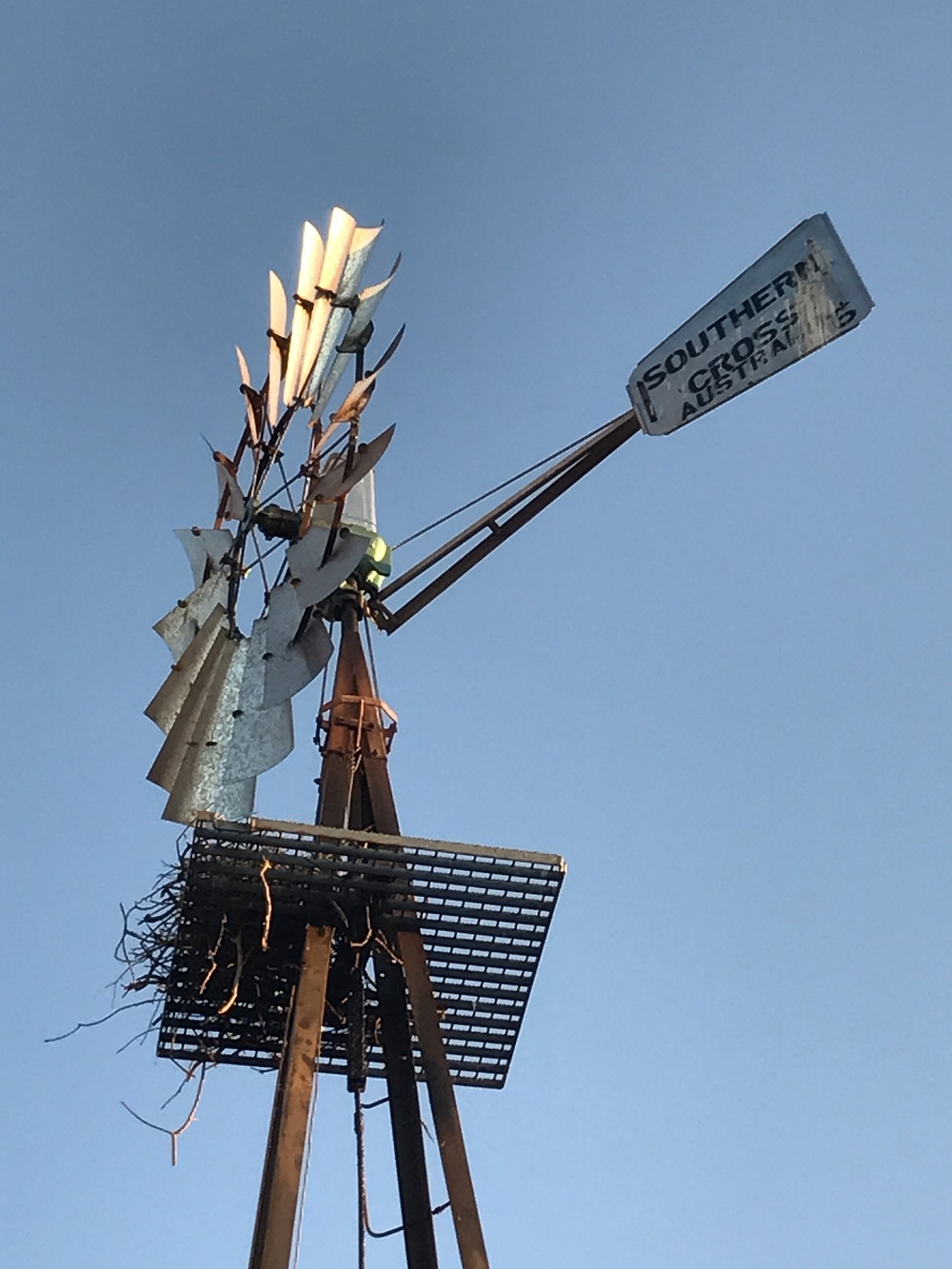
Wind power everywhere but just look, there's a large nest on the upper platform. The birdies wouldn't want to stick their heads up too high!

The intrepid birder (not Lindsay) trying to entice a group of babblers closer to photograph. The things you do when in pursuit of a bird!
As the moon came up, we stood silently watching for the parrots to come to the water trough. They came! We were happy.

​Sandstone and desert flowers - 2 September 2017

Time takes on a different dimension when you're on the road - a week can seem like a month; distance and diversity contribute to that. Having been on the wild flower route and seen so many beautiful flowers and plants, the inland route through goldfield country was quite different. I was happy to be heading back towards the desert. Ah the desert with its big skies, black silent nights and colours ..... glorious! Oh dear, I think I've said that before ... hmmm.
You guessed it - London Bridge.

The patterns and colour in the rock of the land formation here was fascinating.

Sandstone was a rather quick visit but what we saw was impressive. We found some awesome rock formations - like London Bridge near Sandstone. Yes, another one but this one is a bit special. It was formed by weathered basalt believed to be 350 million years old ... wow!
This is Eremophila fraseri- Burra. The flower is small compared to the deep pink calyx in which the developing fruit nestles. The flower is cream and brown with purple dots inside. Emus love these fruits.


Look inside this lovely and you will see dots running back to the rewards in the flower's throat. The insect has to negotiate through a woolly maze to reach its reward. And voila - clever?!

And I saw some wonderful desert plants including sandalwood, hopbush and lots of eremophila. Let me tell you about the clever eremophila. They are desert loving hence the name; the common name is emu and poverty bushes. The greatest concentration of the species occurs in the desert regions of WA. There are basically 2 flower types. One adapted for pollination by insects so it has a landing pad and woolly throat with insect guides on the inside of the flower tube. The other type is adapted to be pollinated by birds. The flower hangs upside down and its stamen daub pollen on the head of birds as they feed on the nectar. The fascinating thing about many of them is that once the flower begins to die back, the calyx starts to colour and enlarge to display the fruit to the birds, particularly emus which consume great qualities. Voila - plant dispersion. A win-win arrangement. I just love them! But I digress and we are back on the road again ..... heading for the highway. Sounds like a song tra la la ......
Santalum spicatum - sandalwood. This tree exploited in the mid 1800s to early 1900s for its perfumed oil and wood which was exported to Asia. Sandalwood is now strictly protected and supplies of wood are severely limited. I was lucky to see this one.

Hopbush - not sure which one.

Now what on earth is this? The soil is mounded around the hole and decorated with narrow leaves. Ant nest, goanna, snake? Hazard a guess anyone?

​From WA wild flowers to WA goldfields -1 to 2 September 2017


We were heading for Marble Bar where there's still gold but also oodles of jasper - one of my favourites. But I digress..... we pulled into a little dot on the map called Payne's Find for fuel and found a gold battery operated by Elaine Taylor. She 'retrained' as a battery operator after reaching the usual retiring age and still churns out the odd ingot but mainly runs tours of the battery. Elaine also consults on regeneration and impact issues in relation to mining activity; her family has been in the area for 100 years. We spent a fascinating hour or so there.
Inside the Paynes Find battery Elaine explains some of the old machinery she maintains.

One of the crucibles and a selection of small ingot moulds.

But we had to push on to Sandstone, another mining location via unsealed road. There we linked up with friends for some tramping in the bush after flowers and birds. On the way we snuck in an overnight camp in a gravel pit. Doesn't sound so romantic but gravel pits offer firm-based off-road camping spots and are often wonderfully secluded. The silence and the night sky are sublime.
Our favourite kind of road! Look at the colours!

We had one visitor at the gravel pit / a dear little skink. He was finger length.

The roadside was dotted with patches of silver tails, one of the mulla mulla family. The contrast between red earth, rocks, scrubby trees and cerulean skies was stunning.

We came upon a bank of paper daisies. They are so delicate and created a wispy pale cloud under the trees.

The ground was dotted with yellow button flower. When you looked closely many of them looked like golden crowns. Quite lovely.

The countryside is dotted with windmills sucking up water from the vast aquifer under the Murchison-Pilbara. We followed the pipe from the pump to a large cattle drinking hole.

And in amongst the dirt and gravel, tiny jewels happily meander providing one more food source for the insects. Systems within systems - it all works!


​Heading out of Perth - 28 to 31 August 2017
Moore River is a fascinating river. Its mouth is often closed with sand (a bit like the Murray) and then water levels rise and all sorts of local changes occur in the aquatic life. In many places it is stained tea colour like the rivers of Tassie. Quite beautiful.

So where was I .....? We seem to be retracing our steps - or close to it. After a delightful 5 days with family in Perth, we back-tracked to Moore River, Guilderton for a couple of days to catch our breath. It's such a delightful and tranquil place. Our last morning there was spent wandering in misty rain through a reclaimed sand quarry looking for orchids and other lovelies. As the rain drops pearled on leaves and petals, they created miniature magnifying lens turning the world upside down and drew your eye for a closer look - fascinating and captivating. Highly romantic I know but flowers tend to transport you (or at least me) into other worlds.
This reclaimed sand quarry was replanted as a memorial garden by O'Deas the funeral family. The only quarrying going on these days is by the ants! It's a very tranquil place where here and there you stumble on a memorial.

Ah one to tick off for me! The gorgeous donkey orchid (Diurus drunmondii). The structure is like many orchids, quite intriguing. It gets the name Diuris meaning double tail from the two green hanging sepals. But it's the two petals on top looking like ears that give the orchid its name.

You might guess that I spent a fair bit of time crab walking and squatting looking at these beauties. The rain drops suspended on this darling really hooked me. For the scientists among you, think of the surface tension etc that allows these little jewels to just hang there. Then explain it to me!

The next few days we meandered through inland wild flower territory on our way to the Great Northern Hwy which would take us back north through gold mining areas to Marble Bar and beyond. Everywhere we went people kept telling us that the flowers this year are not as brilliant as they have been in previous years. We saw few carpets and banks of colour, but we found amazing beauty in colour and form in coastal, inland and desert flora. You just need to look a little closer!
After much searching I think I have this lovely pink tiara identified - but don't quote me! I reckon it is the Isopogon dubius. However I am still a little dubious! If I have it right then its common name is pincushion cone flower. Pretty eh!?

This is Kennedia prostrata or scarlet runner. Leaves are a bit chewed but the bright flowers leap out from the ground

Now this little star which I have always called a fairy flower - don't ask! Maybe it's the sort of thing fairies in childhood books wore on their heads. In reality it is classified as a weed - Guildford grass and other names. I like it! It is endemic to Sth Africa.

Banksia prionotes but I prefer its common name Acorn banksia. The ants were having a field day

Saw only a few of WA's floral emblem - the Anigozanthos manglesii or Mangkes kangaroo paw. This is not a good specimen but it's the best I could find.

This delicate plant is the Guichenotis macrantha (large flowered Guichenotia). A rather ugly name for some a delicate flower. I went looking for the origin and discovered that it was named to honour Antoine Guichenot, the gardeners boy on the scientific journey led by French explorer Baudin to Australia in the early 1800s. It is redeemed!

Just take a look inside! If you were an insect why wouldn't you crawl inside to enjoy the soft mauve light.

No idea what this is other than very pretty. Zoom in and look at the amazing 'landing pad' this flower offers to attract insects to its nectar-depths or stores of pollen.

Blue is not a common colour in the flower world so these Dampiera incana grab your attention. It certainly did that for William Dampier during his second voyage to New Holland in 1699. Hence the name.

The roadside was festooned with banks of the Dampiera. Lindsay and I spent some time looking and clicking.

We didn't see too many massing flowers so when we came upon any, we came to a screeching halt and leapt out of the car with cameras in hand. These are Velleia rosa (pink velleia).

Pink Velleia. Pretty little darlings belonging to the Goodenia family.

Now like me some of you probably thought that all flowers have petals. Right? Well you'd be wrong - like me. This is Keraudrenia integrifolia, or Common Firebush. Its purple 'petals' are the calyx. Quite fascinating. I've learnt a little about calyces but more on that later. (Of course there are the Bougainvillea - I have a lot of learning to do!)