Thursday, 30 March 2017

​Flinders Island - Friday 10 February
Yellow Beach
We woke to a grey misty day wrapping quietly around us cozy and safe like a blanket. It is frog-weather today and tiny scraps of glistening skin on springs are bouncing all around as well as in the toilet! Yes we have a toilet in this bush camp as well a BBQ. The 'gobble bonk' of frogs breaks a delicious silence. We are at Yellow beach and this morning the water beckons but there's little room to dry bathing paraphernalia in the mist-laden air.
Post frog-exploring, we launched into the day with a BBQ breakfast banquet (these things are all relative) - in the mist. Quite delicious but then all food tastes better outside. Then we were off to explore.

Special pellets are in the chalet to feed these darlings
The chalet has sleeping upstairs, fire downstairs 
We discovered Patriarch Inlet and Wild Life sanctuary where pademelons and Bennett wallabies eat out of your hand. We wandered across marshy green then through a little forest of trees and bushes where we happened upon 'George of the jungle' caterpillar out exploring on the end of his silken thread.

This sanctuary is cared for by a small group of dedicated 'friends'. We returned there to camp that night - we slept in the van. There's shower and toilet and a small chalet with a huge fire box and chimney - we lit a fire to dry our clothes and shoes. It all seemed quite luxurious to us - warmth and space can take on such proportions.
The chalet
Flinders Island - Thursday 9 February 2017
Photos, as magical as they may be, miss so much when trying to describe the world out there - sadly, so do words. The sky might be glorious with clouds edged in pale gold or crimson at sunset or drooping under engorged clouds slatey with unshed rain. But without the sound of wind through trees, waves lapping or crashing, or the heavy spicy scent of coastal scrub and ...... I realise that I am waxing a tad lyrical, but often I feel totally inadequate when attempting to describe the world around me.
So where was I? Oh yes heading off to Flinders Island with a young 'Biggles and Algy' tweaking buttons and dials, watching multicoloured screens not much further than an arm's reach away - I am seated right behind the cockpit.
From my tiny window, I look down on pewter seas reflecting a watery sun peaking through its early morning cloud-blankets and suddenly there's the shoreline edged in knitted lace. We are there!
The Furneaux Island group and merely scattered scraps of rock, tips of an ancient rocky land bridge to the mainland now submerged. Once again I am reminded how little I know about our Island nation and resolve to explore more, albeit one tiny corner of it.


We collect our tiny, rather down at the heel, camper van - windows won't close because of moss growing in the runners, shelves fall down when you go around a corner and the gear box is on its last legs, but it's home for a few days - and head off armed with a map and a few provisions towards Strezlecki National Park. We explore coves and silent beaches edged with huge granite boulders smeared with brilliant orange, yellow and white lichen, breathe deep the warm spicy smell of coastal plants - succulents like samphire and pig face, native currant bush (Heath-type plant - this one at least. There seems to be loads which all look like wild currant to me) and listen to the quiet whispering of breezes through she-oaks. Sounds, smells and sights which take me back to holidays on the sand dunes of Pt Lonsdale and so many other coastal places in Australian and elsewhere.
First day we got bogged! Of course - there has to be one in each trip (hopefully only one). So many roads to explore but ..... first we just needed to test the limits of this little sleeper capsule that we'll be holed up in over the next 5 days .... hmmmmmmm! Pushing the van, all good exercise - for me NOT!

Tuesday, 14 February 2017

So what happened between August and now?!
It's February and we are camped beside a tranquil beach with quiet and time to think. Even the waves are simply a gentle lapping. Where in the heck are we? We're camping at Yellow beach, Flinders island within sight of Cape Barren island - in very rustic and rudimentary bushcamp-style and the peace and quiet is heavenly. It's just what I have been hanging out for - my mind is always so noisy!
What have we done since I left off in Georgia - on the travel side of life that is?
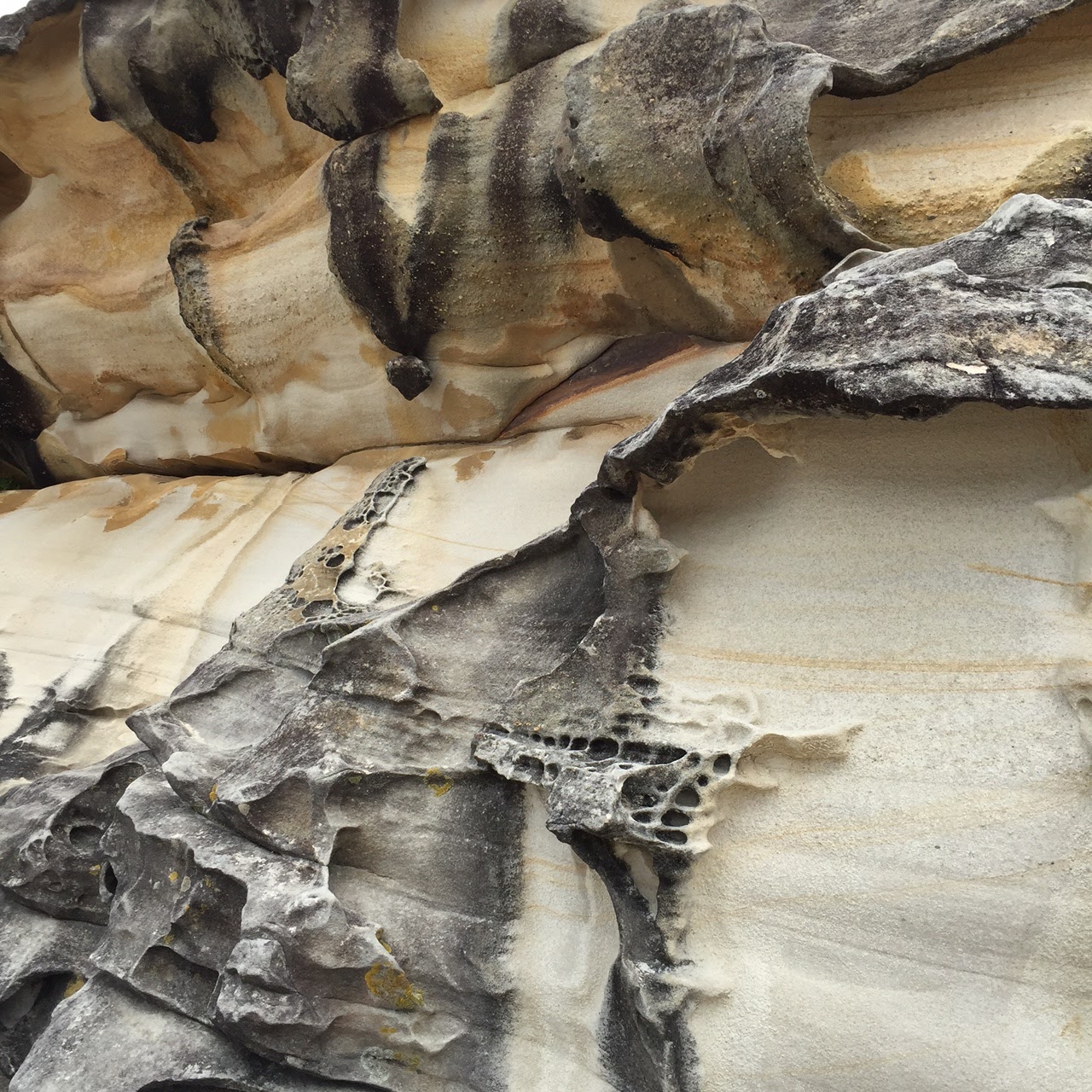
Well .... we first we took a short caravan trip to get some dust in our hair, (test out a few modifications to the caravan) and to get a big eyeful of the glorious night sky in Innes National Park on Yorke Peninsula, SA. The NP encompasses a rather awesome ship wreck coast - yet another one along the southern shores of Oz. It's a wild sea we border to our south! But the coast is awesome - rugged cliffs from which birds hurl themselves only to be picked up and dumped right back by gale-force winds roaring in from the Bight. Cliffs that have been carved into fanciful shapes, tower over a turquoise sea and send out tiny gleams of glitter from remnant shards of gypsum embedded in the tracks - tons of gypsum were once 'collected' here some of which ended up in our schoolrooms. Remember chalk, the not so nice chalk dust, cleaning the blackboard ? seems a long while ago.
The patterns give pause for thought - I need Geology 101!
Then we hopped on a train and went to Sydney for a month. Boy talk about contrasts! From gypsum-encrusted lakes and gale force south-westerlies blowing in from the Southern Ocean to Potts Point, the Vietnamese fish markets of Cabramatta (don't ask - it was on the to do list!) and driving south-easterly winds piling in from the Pacific Ocean sculpting similar phantasmagorical works of art in east-facing sandstone cliffs - this is one small corner of Australia. Wonderful is it?!
In Sydney we joined a group of birdwatchers and headed miles out to sea to the edge of the continental shelf. Boy were we sick ... ugh! It was way too rough. We were on the trail of the pelagic birds that sail over those waters waiting for the rich pickings welling up from the deeps. And they're not the only ones.... we saw humpback whales, dolphins and an enormous sun fish - a first for me and what a huge, strange creature it seemed to me.
And before we returned to Melbourne, we completed our walk around Sydney harbour, wahoo! According to the map, we'd walked 60km PLUS 50-60 ks of side loops as well as some repeated favourite segments over 4-5 years, a little bit at a time in snatched escapes to Sydney. Who knows how far we actually walked. The harbour is superb, an experience which takes you clambering over rocks and through tidal pools one minute and then up steep steps to burst out into suburbia and fragrant gardens the next. And always the vistas are beautiful, awesome, and spectacular. We enjoyed every step - almost!
Now we are exploring Tassie and some of its island. It promises to be a journey to remember. Talk to you anon!
[Posted some time later when we have internet access  albeit intermittent - such are the joys of travel! And incidentally we left Flinders Island in 60 k/h winds.  What a contrast]

Sunday, 5 February 2017

Tomorrow and many tomorrows - Tasmania! 4 Feb 2016


What time does the sun get up? after us for sure tomorrow ... ugh!  We load the van and months worth of gear and food etc and head for Tassie for a new voyage of discovery - Tassie's islands, Bass Strait islands, coastal and mountain wilderness, lakes and rivers, 'bush walking' and  .... general gypsy-like days of bliss.  I'll catch up with you along the road somewhere.

Tuesday, 5 July 2016

July 5 The end of a wonderful adventure!

From Far East Russia we had travelled to the mysterious lands of the Caucasus – what an experience! Da svidaniya (Russian is still the language of the older generation in former Soviet countries).

Our thanks to Sundowners Overland www.sundownersoverland.com for a wonder-filled experience.  Would we do it again? Absolutely! Our favourite places? – just about everywhere!  And special thanks to Bev Edwards, our Personal Travel Manager, who managed so much of this whole wonderful trip for us so that our dreams came alive.  Contact her if you want to do something a little different but you have to have a dream! E: bev.edwards@travelmanagers.com.au 


Monday, 4 July 2016

July 3 - 4 Fortresses, Cave cities and the end of our journey

We spent the night in Akhaltsikhe before heading further south towards the border with Turkey from where many invading forces pushed north into the heart of Georgia – we were on our way to visit the medieval cave city of Vardzia.

The ground was a carpet of delicate flowers - an artist's palette

These are ancient lands 
The confluence of the Mtkvari and Paravani Rivers

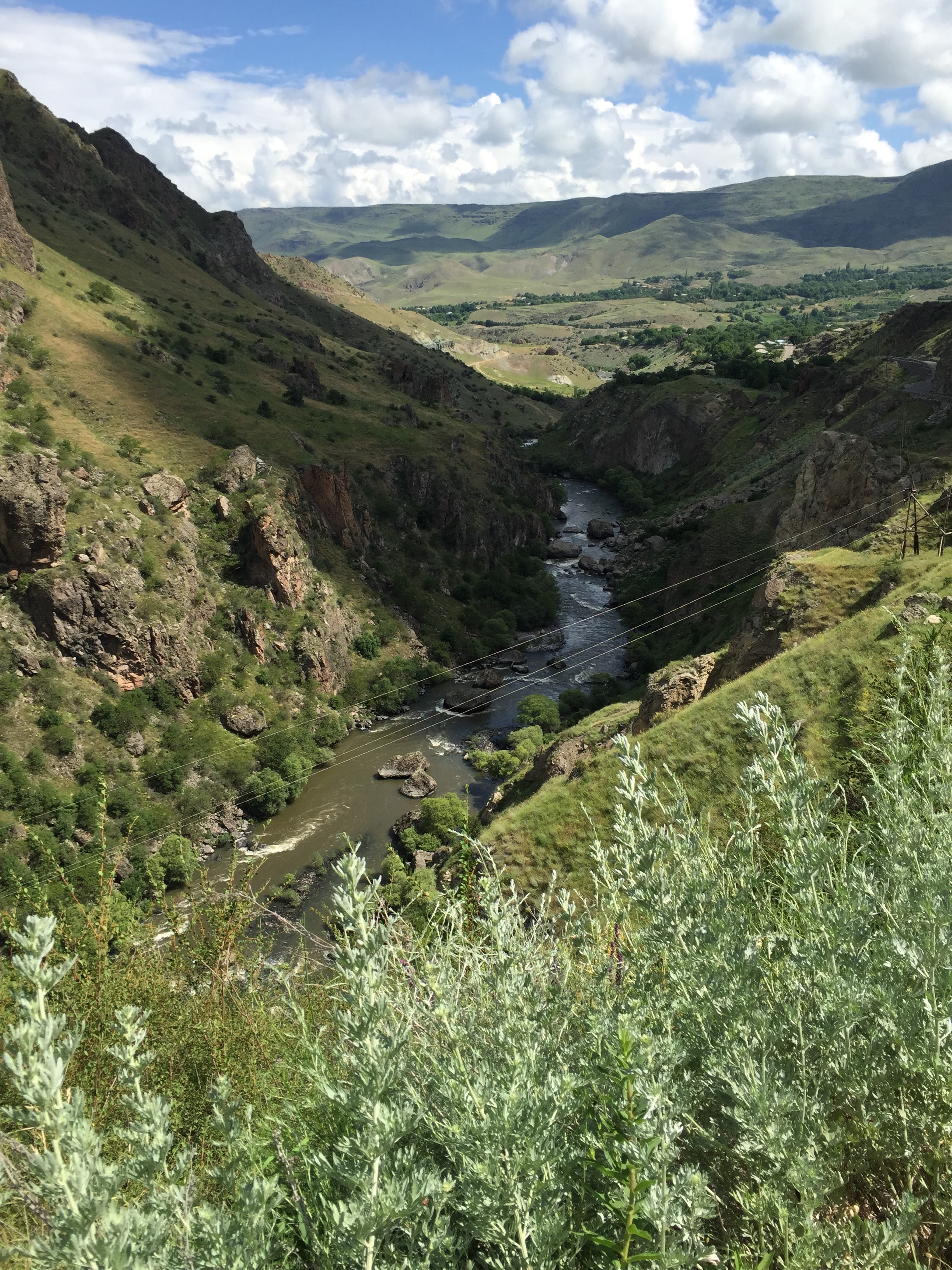
The drive southeast from Akhaltsikhe took us through beautiful wilderness. The road followed the course of the Mtkvari River through narrow canyons and spectacular valleys full of lush green and carpets of wildflowers. On the way we stopped at the Khertvisi Fortress. Khertvisi derives from the Georgian word meaning the confluence of rivers. The fortress is situated on the high rocky hill in the narrow canyon at the confluence of the Mtkvari and Paravani Rivers.  Like other fortresses, it was strategically positioned to stop invading forces.  Not so successfully it seems.  During the Russo-Turkish War of the early 1800s, the Turks besieged the fortress and slaughtered the Armenian part of the population. Such a fierce and bloody past! The age of the fortress in indeterminate but according to a local legend, Khertvisi was once destroyed by Alexander the Great on his march eastward in the C4th BC and since then has been reconstructed and invaded numerous times over the centuries. The current structure was built in the C10-11.

We cross the Paravani River to reach the Khertvisi Fortress
The road we were taking south followed the course of the Mtkvari River (also known as the Kura River), through narrow canyons and spectacular valleys. This region close to the border with Turkey is, or was, one of the Black Sea routes of the Old Silk Road and along its length many medieval cave fortifications and dwellings existed. Georgia was a country invaded many times over the millennia. Archaeological excavations have shown that the region around Vardzia was inhabited during the Bronze Age and cave settlements near by date from at least C5 BC.
It was a glorious drive but then we rounded a bend in the river and there it was – the incredible medieval cave city of Vardzia excavated out of the slopes of Erusheti Mountain in the Lesser Caucasus.
King Giorgi III built the fortifications here in the C11 after 10,000 Turkish troops marched into Georgia. Happily, they were defeated by a bold Georgian army of just 2,000 men. His niece and successor, Queen Tamar, subsequently established a monastery that grew into a virtual holy city housing around 2000 monks. Tragically in C13, Vardzia suffered a major earthquake which sheared off the face of the mountain exposing this magnificent labyrinthine C11 cave city. 
We saw a number of caves which could have given access to the cave city

Vardzia at a distance - mind boggling

Sliding doors?! Sliding mountains - an amazing sight revealed!
It stretches over half a kilometre along the River Mtkvari and had up to 19 tiers which once contained ~3000 caves which served as refectories, pharmacies, dwellings, with many wine cellars along tunnels carved into the belly of the mountain.  The clever monks designed an intricate irrigation system to ensure the supply of clean drinking water into the city and to irrigate the terraced slopes of Erusheti Mountain overlying the city. Once it also housed thousands of troops as it was a huge defence point guarding the passage north as well as a defence against the Mongols. The access to this hidden city was through a concealed tunnel that had its entry near the banks of the river Mtkvari. In C16 the Georgian army was defeated by the Persians in a battle in the caves themselves and Vardzia was looted. 
Today Vardzia is again a working monastery, and some monks inhabit the caves. They have a flying fox to bring goods to the monastery.

We popped in and out of cave openings - remembering that there was a long drop down!
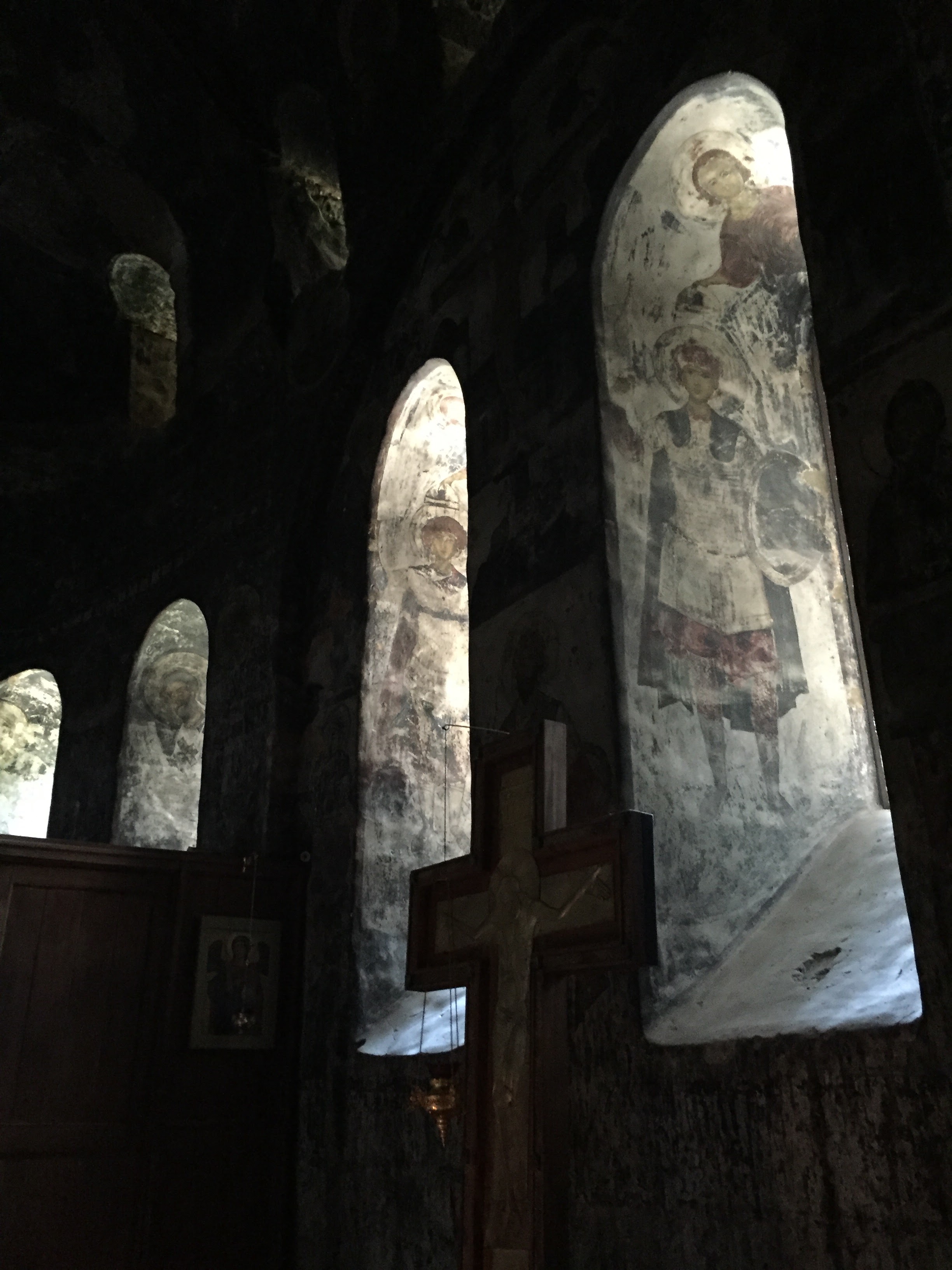
We climbed up from the valley floor and explored as much as we could. The monastery was off limited, but we visited the rather other-worldly Church of the Assumption. Once completely entombed by the mountain, now it projects into the light. It felt spiritual, quite mystical. The interior of the Church almost made me weep with its shadowy atmosphere where dust motes floated down the thin beams of watery light that filter through deep slots in the thick walls to highlight faded frescoes rich in history.
From near and far the views were spectacular!

The sides and roofs were blackened by centuries of flame torches


The Church of the assumption

The archways letting in light was covered in beautiful frescoes

'Outside' the Church of the Assumption
We ventured deep inside where the walls were blackened by centuries of flame torches

The remaining monastery was fenced off.
The views were absolutely spectacular! But having climbed up there, we had to descend! Two of the women in front of me were terrified going down to the valley floor but they made it with lots of nervous laughter. We all embraced once we were on level ground. They were part of a lovely Georgian family who, after the mandatory group photos, invited us to share their BBQ lunch. That would have been a wonderful finish to a rather spectacular day but we had to press on as we needed to be back in Tbilisi that evening.   
We descended to slopes though tunnels cut into the slopes
Sadly we turned our backs on Vardzia and headed east to Tbilisi travelling back along the river that Jason and the Argonauts sailed in search of the Golden Fleece and passing Paravani Lake, a volcanic lake located over 2,000 m above sea level. The lake is fed by snow, rain and underground springs and is frozen during winter when the ice can get to almost 1 m thick.  Thus ended a fantastic day. 
Back in Tbilisi we explored a little closer to our hotel - a creek and waterfall fed by mountain springs.  
The mineral baths


Sadly, the next day we were due to fly out heading for home. What an astonishing and breathtaking country! We had traversed the few coveted corridors that Georgia offers as passages between Asian to Europe, explored ancient sites of great religious and historic significance, clambered through shoulder high flowers and herbs to visit mountain villages and sample delicious wholesome foods, shared roads with cows, horses and pigs as we crisscrossed this stunningly beautiful country, sat down to eat with delightful, welcoming Georgians - and guzzled its delicious wine. What more could you ask for! Although a rather rushed 12 days, it was an epic journey and a fantastic adventure. We travelled about 2000 Km through Armenia and Georgia. 
Unfortunately, our planned trip to Istanbul and the Bosphorus, the Sea of Marmara and the exotics of the souk, mosques and ancient laneways was thwarted by a 'shooting incident' in Istanbul which left over 40 innocent people dead (and our plans in a mess!). It was a sad ending to our journey ..... but we will return once sanity returns to that old city. 


Saturday, 2 July 2016

July 1 - 2 Prometheus, Kutaisi and Gelati


Mt Shkhara shrouded in cloud as we left Svaneti
As we drove through the valleys of the Greater and Lesser Caucasus mountains, we passed many fortresses and watchtowers, evidence of Georgia's key position as a major trade corridor in times past but also a reminder of invading forces that swept through these mountainous gorges. Today it is still a key land passage between Asia and Europe. More on that a little later. For now, I want to relive idyllic days travelling through wooded and craggy mountains where live four species of bear, deer, martens, wild pig, jackals, squirrels, countless species of birds - and glorious wildflowers and herbs! Everywhere along those roads, and through large towns as well, cows sauntered, some with bells tinkling as they grazed. If they bothered to look at us encased in our zappy 'jeep', it was but a casual glance as we maneuvred past them. No question of who had right of way!  We passed donkeys pulling laden carts as well as bicycle carts. Sleek horses and grizzled hairy pigs chomped their way through lush grasses, herbs and flowers. They were slightly more wary of us than the laconic cows, but only just.

We were heading for Tskaltubo and a visit to the natural grotto 'Prometheus Cave' nearby.  On the way we drove by the Rioni River - once called the Phasis River. 

The Riono River
This was the land of Jason and the Argonauts! Legend has it that around 1300 BC, the Argonauts accompanied Jason to Colchis, western Georgia through which we are travelling, to explore this river in search of the Golden Fleece.  It was an ancient practice to filter river water through fleece to trap alluvial gold. In Greek mythology, however, the Golden Fleece is the fleece of the golden-woolled winged ram, which was held in Colchis. The fleece is a symbol of authority and kingship.  Choose which ever story you like best but the practice of gold fleecing is still practiced in Svaneti. When we passed by the Rioni River, it was clogged with tree pieces washed down from the mountains.
We eventually reached the Cave of Prometheus which was carved out by an underground river. According to legend, Prometheus, the Titan, was chained to a rock (or pillar) near here and Zeus sent an eagle to eat his liver. In the gory horror of legends, the liver re-grew every night and the eagle returned each day to perpetually torment Prometheus.  This was Prometheus’s punishment for stealing fire from Olympus and giving it to humans. Fortunately, he was rescued by Hercules.  
The entrance to the caves was long and dark
Georgia really is a mysterious place with a magical mythical history that reaches back to a very distant past. But to return to now and the cave, we walked for a very long way through dripping caves adorned with weird and wonderful shapes. That night we were entertained by a very talented group of performers in national costume, playing traditional instruments, singing and dancing. The Georgians have a unique singing and dancing style.
Nino with the leader of the dance troupe
Next day we arrived at Kutaisi. After the silence of the mountains, Kutaisi seemed a big crowded city. We were here to visit more ancient churches but first we wandered through a Saturday morning market where we were assailed by delicious smells and tastes - local cheeses, honey and spices and even chacha - that fiery Georgian brandy/vodka which is powerful enough to cure everything from toothache to ingrown toenails! At 10 in the morning! it gets your heart galloping and ready to take on the world which in this case was simply a stroll in a delightful city park, nodding to the local Saturday morning crowd leisurely drinking coffee, reading the paper, strolling with dogs and children. 
A wonderful fountain in Kutsaisi city centre
Gelati Cathedral
Kutaisi is one of the main religious, cultural and intellectual centres in Georgia and is home to the Gelati Monastery and Cathedral built in 1106 by King David the Builder. The monastery was one of the largest Orthodox monasteries in medieval Georgia. The church and monastery complex boasted a place of learning, an Academy which attracted some of the most celebrated Georgian and international scientists, theologians and philosophers. According to medieval chroniclers, the academy became a second Jerusalem for learning all that is of value, and a second Athens for the teaching of knowledge. The whole monastery complex is being restored using original methods.
These excavations uncovered ancient qvevri (wine vats) which I believe were used to hide important documents  

The Academy almost restored
King David who built this cathedral and academy was considered to be the greatest and most successful Georgian ruler in history (C12th). He succeeded in driving the Seljuk Turks out of the country and his reforms enabled him to reunite the country and bring most of the lands of the Caucasus under Georgia’s control. David chose to be buried under the stone inside the main gatehouse of the Gelati Monastery so that anyone coming to his beloved Gelati Academy stepped on his tomb first, a humble gesture for a great man. The symbols on the gate talk about King David. The Georgian letters are quite beautiful. Like Armenia, Georgia has its own unique alphabet with 33 letters and is thought to be related to the Aramaic spoken in the time of Jesus. 

The bronze South Gate
Inside the cathedral was magnificent and the frescoes, many of which had been restored, were simply breathtaking. 


We also visited the C11th Bagrati Cathedral which, along with the Gelati Cathedral, was listed as a UNESCO World Heritage site. Bagrati had suffered heavy damage throughout centuries and was reconstructed to its present state over many decades. As a result of those major reconstructions the cathedral was removed from the World Heritage listing.  
Bagrati Cathedral

The newly reconstructed parts of the cathedral complax stand in stark contrast to the old buildings

Part of the old fortificaitons